

Puglia
Puglia, also known as Apulia, is a southern region in Italy that forms the "heel" of the country's "boot" shape. It is known for its long Mediterranean coastline, whitewashed hill towns, centuries-old farmland and a diverse culinary history.
One of the region's standout cities is Lecce, often called the "Florence of the South" for its beautiful baroque architecture. Other major cities in Puglia include Bari, Taranto, and Foggia. The region is also home to the stunningly unique Trulli of Alberobello, a UNESCO World Heritage site featuring white cone-roofed houses.
Puglia is a major agricultural region, producing much of Italy's wine and olive oil. It boasts a rich culinary tradition, with dishes that heavily feature fresh, local produce, seafood, and handmade pasta.
Puglia's landscape ranges from the dramatic cliffs and grottoes of the Gargano Peninsula to the sandy beaches of Salento. It also includes two national parks and numerous nature reserves.
The region is steeped in history and culture, with influences from the Greeks, Romans, and Normans, among others. Here, visitors can explore countless castles, cathedrals, and historic sites, perfect for those who are keen in history and architecture.
Puglia's tranquil countryside, beautiful beaches, delicious food, and rich history make it a perfect destination for travelers seeking an authentic Italian experience.
Denmark
Denmark, officially known as the Kingdom of Denmark, is a Nordic country in Northern Europe. It is the smallest of the Scandinavian countries and is bordered by Germany to the south and is otherwise surrounded by sea, with the Baltic Sea to the east and the North Sea to the west.
Denmark has a total area of 42,924 square kilometers. The country comprises of a large peninsula, Jutland, and an archipelago of 443 named islands. The largest of these islands are Zealand, Funen, and the North Jutlandic Island.
The country has a temperate oceanic climate, characterized by mild winters and cool summers. The terrain is characterized largely by flat arable land, sandy coasts, with a rolling plain and low, flat topography.
As of 2021, the estimated population of Denmark is approximately 5.8 million people. The capital and largest city is Copenhagen. The official language is Danish, and the official currency is the Danish Krone (DKK).
Denmark is a constitutional monarchy, which means the country recognizes a monarch as an official head of state, but the monarch's powers are outlined by a constitution. The country is famous for its eco-friendliness and is considered one of the world's most environmentally friendly countries.
Denmark's economy is characterized as a mixed system, featuring a high standard of living and high amounts of public spending. The country is known for its strong welfare system, with healthcare, education, and elderly care being largely state-funded.
Culturally, Denmark is known for its contributions to literature, music, cinema, architecture, and gastronomy. It is also the birthplace of the famous fairy tale writer Hans Christian Andersen and the philosopher Søren Kierkegaard. Denmark is also renowned for its modern design, particularly in furniture, ceramics, and architecture.
Denmark is famous for its Viking history, its historic cities, and beautiful landscapes. The country is also known for its high standard of living, social security, and progressive policies. It consistently ranks high in various metrics of national performance, including education, healthcare, protection of civil liberties, democratic governance, prosperity, and human development.
Alabama
The Alabama wine region, though not as widely recognized as some other American wine-producing areas, offers a unique and burgeoning wine culture. Nestled in the southeastern United States, Alabama's wine industry benefits from a warm climate and diverse soil types, which contribute to the cultivation of a variety of grape species. Muscadine grapes, native to the southeastern U.S., are particularly prominent in this region due to their adaptability to the local climate and resistance to pests and diseases.
Wineries in Alabama often focus on producing sweet and fruit-forward wines, reflecting the characteristics of the muscadine grape. However, there is also a growing interest in cultivating traditional European grape varieties, such as Cabernet Sauvignon and Chardonnay, which are being experimented with in some vineyards.
The Alabama wine trail offers visitors a chance to explore the state's scenic landscapes while sampling a range of wines. Many wineries provide tours and tastings, allowing guests to learn about the winemaking process and the unique qualities of Alabama wines. The region's wine festivals and events further highlight the local wine culture, drawing enthusiasts from across the country.
Overall, the Alabama wine region is characterized by its dedication to showcasing local flavors and its commitment to expanding the diversity of wines produced in the state. As the industry continues to grow, it contributes to the broader recognition of Alabama as an emerging player in the American wine scene.
Israel
Israel, formally known as the State of Israel, is a country located in the Middle East region of Asia. It is bordered by Lebanon to the north, Syria to the northeast, Jordan to the east, Egypt to the southwest, and the Mediterranean Sea to the west. Israel also has control over the West Bank and Gaza Strip, though these areas are disputed territories with the Palestinians.
Israel was established in 1948 as a homeland for the Jewish people, but its creation was followed by a war with neighboring Arab states. The country's modern history has been marked by ongoing conflict, particularly with the Palestinians and other Arab nations.
It has a diverse culture, with a mix of Jewish communities from around the world, as well as substantial Arab and Christian populations. Hebrew and Arabic are the official languages. Jerusalem is its capital and largest city, though this is controversial as East Jerusalem is considered occupied Palestinian territory by the international community.
The nation is known for its high standards of living, strong education system, and robust economy. It is a world leader in technological and scientific research, a pioneer in high-tech and start-up companies.
Israel is a democratic republic with a parliamentary system. It also is renowned for its historical and religious significance, housing sites sacred to Judaism, Christianity, and Islam. Despite its relatively small size, Israel's landscapes are varied ranging from desert in the south, to mountains and valleys in the north.
Lisboa
Lisboa, also known as Lisbon, is the capital city and largest city in Portugal. Located on the western coast of the country, it is the westernmost capital city in mainland Europe. Lisboa boasts a population of over 500,000 people within its city limits, with around 2.8 million people in the greater metropolitan area.
At over 2,700 years old, Lisboa is one of the oldest cities in the world. It has a rich history, having been inhabited by Celts, Romans, Visigoths, Moors, and more. The city is known for its stunning mix of historic architecture and modern developments.
One of Lisboa’s most significant historical landmarks is the Belem Tower, a 16th-century fortification that once guarded the entrance to the city's harbor. The Jerónimos Monastery, a UNESCO World Heritage Site, is another must-see, showcasing beautiful examples of Manueline architecture.
Lisboa is also famous for its hilltop viewpoints, or "miradouros," which offer breathtaking panoramic views of the city. Its charming old neighborhood, Alfama, is famous for its narrow alleyways, historic buildings, and fado music.
Lisboa has a Mediterranean climate, with mild, rainy winters and warm-to-hot, dry summers. The city is also known for its vibrant food scene, sporting a variety of both traditional Portuguese and international cuisine.
The city is a major economic hub, supporting sectors such as finance, commerce, media, entertainment, arts, international trade, education, and tourism. Lisboa is also a transportation hub, featuring an international airport and a major seaport.
Portugal
Portugal, officially known as the Portuguese Republic, is a country located in Southern Europe on the Iberian Peninsula. It is the westernmost country of mainland Europe, bordered by Spain to the east and north, and by the Atlantic Ocean to the west and south. The country covers an area of approximately 92,090 square kilometers.
Portugal has a population of over 10 million people. The official language is Portuguese and the capital city is Lisbon. Porto is another major city. Portugal is a democratic republic with a president as the head of state and a prime minister as the head of government.
The country has a mixed economy and is known for its high-quality wine and cork production. Tourism also plays a significant role in Portugal’s economy.
Portugal has a rich history dating back to the Early Middle Ages. In the 15th and 16th centuries, Portugal established the first global empire, becoming one of the world's major economic, political and military powers. This era is known as the Age of Discovery, during which explorers like Vasco de Gama charted new routes to Africa, Asia and the Americas.
From its beautiful coastal regions like the Algarve to its charming cities with historic buildings and cobblestone streets, Portugal is known for its distinctive culture, warm climate, and welcoming people. The nation's cuisine is highly prized, especially their seafood dishes and pastries.
Portugal is also notable for its contribution to world music with the unique genre known as Fado, a melancholic style of music associated with urban life. The country is a member of the United Nations and the European Union.
Restaurant
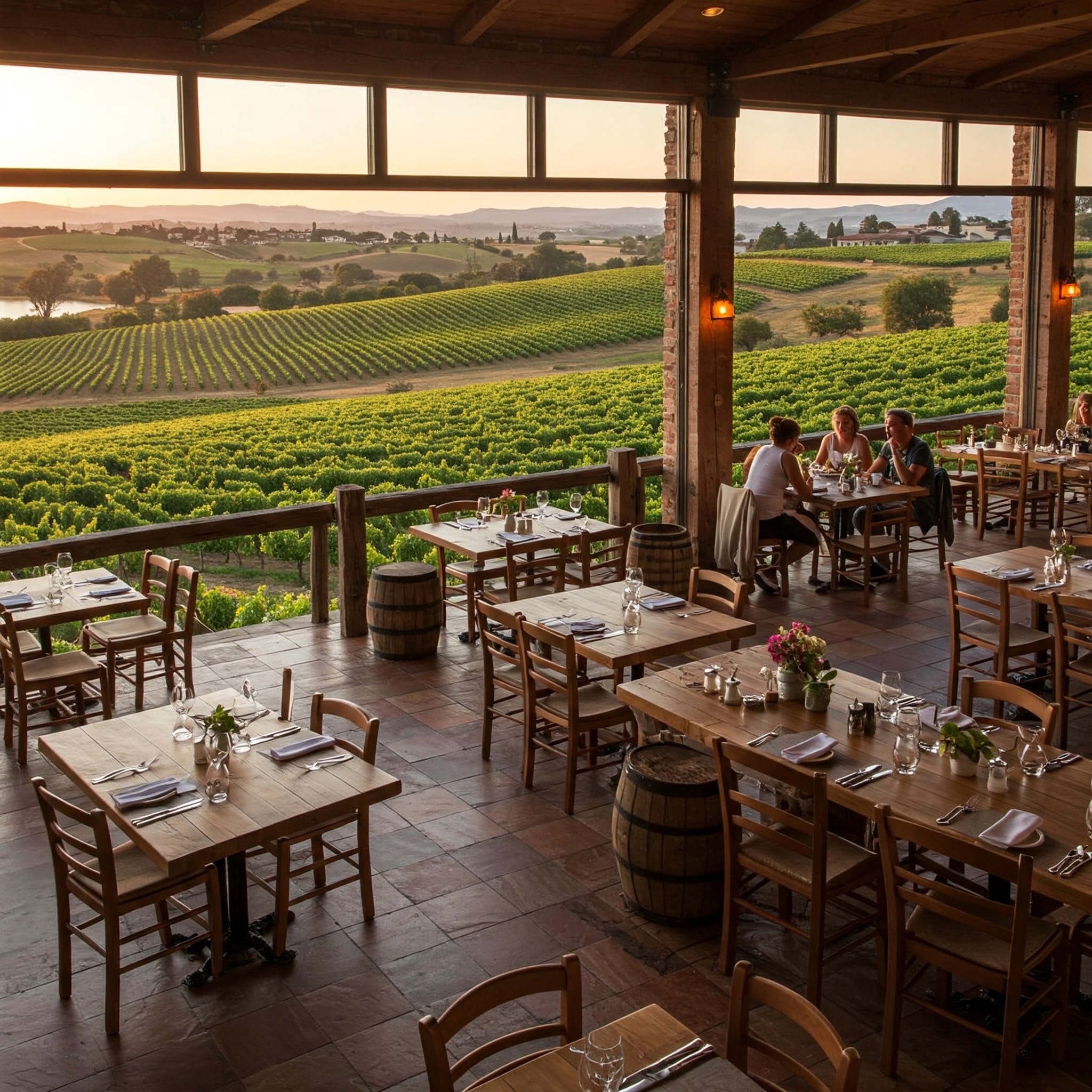

A restaurant at a winery typically offers a unique dining experience that combines delicious food with the ambiance of the vineyard. Guests can enjoy a variety of dishes made with locally sourced ingredients that complement the wines produced on the property. The restaurant may feature indoor and outdoor seating options, allowing diners to take in the scenic views of the vineyard while enjoying their meal. The menu is often designed to pair well with the winery's wines, offering recommendations for which dishes go best with each varietal. Overall, dining at a restaurant at a winery provides a memorable culinary experience that celebrates the connection between food and wine.
Los Angeles County
Los Angeles County, often referred to as L.A. County, is the most populated county in the United States, with a population of over 10 million people. Located in the southern part of California, it covers approximately 4,751 square miles, with roughly 70 miles of coastline along the Pacific Ocean.
The county consists of 88 incorporated cities, with the city of Los Angeles being the largest. It is known for its mediterranean climate, cultural diversity, and the entertainment industry. Hollywood, which is located in Los Angeles County, is often regarded as the "Film Capital" of the world.
L.A. County also includes other famous locales such as Beverly Hills, known for its luxury lifestyle and shopping; Long Beach, with its bustling port and vibrant nightlife; Santa Monica, with its beautiful beaches and iconic pier; and Pasadena, home to the annual Rose Parade and Rose Bowl game.
The county has a very diverse economy. Aside from entertainment, it is also a leading hub in the world for fashion, aerospace, and healthcare. The county is home to numerous educational institutions, including the University of Southern California, the California State University system, and several community colleges.
In terms of natural beauty, Los Angeles County has everything from beautiful beaches to rugged mountains. Local highlights include the Santa Monica Mountains, Angeles National Forest, and Griffith Park, one of the largest municipal parks with urban wilderness areas in the United States. The county also contains several important cultural landmarks, including The Getty Center, Los Angeles County Museum of Art (LACMA), and the Walt Disney Concert Hall.
Syrah
Syrah, also known as Shiraz, is a dark-skinned grape variety grown throughout the world and used primarily to produce red wine. It is one of the most popular grape varieties in terms of global plantation.
The Syrah varietal produces a bold, full-bodied, and complex wine. These wines typically have medium to high levels of tannins which give them a hearty structure and the ability to age well. The flavors you might find in Syrah wines often include dark fruits such as plums, blackberries, and blueberries, along with earthy and spicy notes of black pepper, mint, and cocoa.
The taste and characteristics of Syrah wine can vary greatly depending on the climate and soil where the grapes are grown. In warmer climates, like Australia and California, Syrah tends to produce wines with more fruit-forward flavors, a smoother tannin structure, and higher alcohol content. On the other hand, in cooler climates, such as Northern Rhône Valley in France, Syrah wines typically have more floral and spice notes, along with higher acidity and tannin levels.
<div class="wikipedia-data"><p><b>Syrah</b> (<span></span>), also known as <b>Shiraz</b>, is a dark-skinned grape variety grown throughout the world and used primarily to produce red wine. In 1999, Syrah was found to be the offspring of two obscure grapes from southeastern France, Dureza and Mondeuse Blanche. Syrah should not be confused with Petite Sirah, a cross of Syrah with Peloursin dating from 1880.
</p><p>The style and flavor profile of wines made from Syrah are influenced by the climate where the grapes are grown with moderate climates (such as the northern Rhone Valley and parts of the Walla Walla AVA in Washington State) tending to produce medium to full-bodied wines with medium-plus to high levels of tannins and notes of blackberry, mint and black pepper. In hot climates (such as Crete, and the Barossa Valley and McLaren Vale regions of Australia), Syrah is more consistently full-bodied with softer tannin, jammier fruit and spice notes of licorice, anise and earthy leather. In many regions the acidity and tannin levels of Syrah allow the wines produced to have favorable aging potential.</p><p>Syrah is used as a single varietal or as a blend. Following several years of strong planting, Syrah was estimated in 2004 to be the world's 7th most grown grape at 142,600 hectares (352,000 acres). It can be found throughout the globe from France to New World wine regions such as: Chile, South Africa, the Hawke's Bay, Waiheke, New Zealand, California and Washington. It can also be found in several Australian wine regions such as: Barossa, Heathcote, Coonawarra, Hunter Valley, Margaret River and McLaren Vale.</p><div class="wikipedia-link">Wikipedia: <a href="https://en.wikipedia.org/wiki/Syrah">Syrah</a></div></div>