

Dornfelder
Dornfelder is a dark-skinned variety of red grape of German origin. It was developed in the mid-20th century by crossing the grape varieties Helfensteiner and Heroldrebe. Dornfelder has a deep, dark color, and it is known for its rich, fruity aromas and flavors that often reflect cherries, blackberries, and other dark fruits, sometimes even spicy or smoky notes.
Dornfelder is mainly grown in Germany where it is the second most planted red grape variety. It produces wines that are often consumed young. They can be made in a light, Beaujolais style, but also in more oak-aged, full-bodied versions. Furthermore, Dornfelder has a good natural acidity and tannin structure making it suitable for sweetness balance. This means its wines can range from dry to quite sweet.
Though it's mostly known in Germany, Dornfelder has also found some success in other parts of the world, including the United States and the United Kingdom.
<div class="wikipedia-data"><p><b>Dornfelder</b> is a dark-skinned variety of grape of German origin used for red wine. It was created by August Herold (1902–1973) at the grape breeding institute in Weinsberg in the Württemberg region in 1955. Herold crossed the grape varieties Helfensteiner and Heroldrebe, the latter which bears his name, to create Dornfelder. Helfensteiner (Frühburgunder/Pinot Noir Précoce × Trollinger/Schiava Grossa) and Heroldrebe (Blauer Portugieser × Blaufränkisch/Lemberger) were both crosses created some decades earlier by Herold. Dornfelder received varietal protection and was released for cultivation in 1979. It was named in honor of Immanuel August Ludwig Dornfeld (1796–1869), a senior civil servant who was instrumental in creating the viticultural school in Weinsberg.</p><p>Traditionally, the red wines of Germany were mostly pale and light-bodied, but new breeds of dark-skinned grapes led by Dornfelder have allowed the production of more internationally styled reds. Dornfelder
has a depth of color, good acidity and the ability to benefit from barrique aging and the associated oak flavours. In comparison to traditional red wine varieties of Germany, Dornfelder is easier to grow than Spätburgunder, has better resistance to rot than Blauer Portugieser (as well as deeper color, more powerful flavours and more tannin), has stronger stalks than Trollinger, ripens earlier than Lemberger, and achieves higher must weights, i.e., higher natural alcohol levels than most of these varieties. Dornfelder can be very productive, and yield up to 120 hectoliter per hectare, but quality-conscious producers typically keep yields much lower. Higher-quality Dornfelder wines are velvety textured, slightly floral, often show flavours of plums, blackberries or cherries, and are typically oaked. Sometimes the wines have a hint of sweetness.</p><p>Dornfelder is the second most grown red wine grape variety in Germany. Steadily increased plantings throughout the 1980s and 1990s allowed it to overtake Blauer Portugieser in 2001. It has established itself in most German regions, and been particularly successful in Rheinhessen and the Palatinate. In 2006, Dornfelder was grown on 8,231 hectares (20,340 acres) in Germany, and no longer has an increasing trend.</p><div class="wikipedia-link">Wikipedia: <a href="https://en.wikipedia.org/wiki/Dornfelder">Dornfelder</a></div></div>
St Laurent
St Laurent is a highly aromatic red wine grape variety primarily found in Austria, but also grown in Germany, Czech Republic, and Slovakia. It is often compared to Pinot Noir due to its similar characteristics, such as its medium body and fresh acidity.
The varietal offers a rich and robust flavor profile, featuring deep notes of ripe cherry, blackberry, spice, and earthy undertones. It produces wines with a velvety texture, balanced acidity, and medium to high tannins which often age well, developing complex secondary flavors.
Wines from the St Laurent varietal typically showcase a deep ruby color. They are renowned for their elegance and can be enjoyed on their own or paired with food, particularly red meats, game, poultry, and aged cheeses. Despite its high quality, this varietal remains relatively unknown outside of its native regions.
<div class="wikipedia-data"><div class="wikipedia-link">Wikipedia: <a href="https://en.wikipedia.org/wiki/St Laurent">St Laurent</a></div></div>
Rose Brut
Rose Brut is a type of sparkling wine that has a vibrant pink color. This type of wine typically has fruit-forward flavors of strawberry, cherry, and raspberry, along with floral notes. It's often made with a mix of red and white grapes, which give it its unique color. While it's made in various wine regions worldwide, it's most commonly associated with the Champagne region of France. The "Brut" in its name indicates that the wine is dry, meaning that it has a minimal amount of residual sugar. This gives Rose Brut a crisp, refreshing taste that makes it perfect for toasting and pairing with a variety of dishes.
<div class="wikipedia-data"><div class="wikipedia-link">Wikipedia: <a href="https://en.wikipedia.org/wiki/Rose Brut">Rose Brut</a></div></div>
Ehrenfelser
Ehrenfelser is a white wine grape variety of German origin. It was created in the 1920s by crossing the Riesling and Silvaner grape varieties. It is mostly grown in the Rhineland region in Germany and in the Okanagan Valley in Canada.
The Ehrenfelser grape produces aromatic, rich wines with high acidity and flavors reminiscent of apricots, peaches, honey, and citrus fruits. It also often has floral characteristics, making it similar to Riesling in many ways. However, it matures earlier and is less susceptible to disease.
Wines made from the Ehrenfelser varietal are usually consumed young and most often used for making ice wine due to the grape's consistency and the high sugar levels that can be achieved. Ice wines are sweet and often served as dessert wines. However, some winemakers also use the Ehrenfelser for making dry or off-dry wines.
<div class="wikipedia-data"><p><b>Ehrenfelser</b> is a white wine grape variety of German origin. It was created by Dr. Heinrich Birk (1898-1973) at the Geisenheim Grape Breeding Institute in 1929, by crossing Riesling with what was thought at the time to be Silvaner, but DNA markers have since indicated it was the Alsace variety Knipperlé.</p><p>Ehrenfelser was first grown primarily in the Palatinate and Rheinhessen regions in Germany, however as is the case with most white German "new crosses", plantings within Germany have decreased considerably in recent years. In 2006, only 112 hectares (280 acres) of plantings remained, down from 255 hectares (630 acres) in 1999.</p><p>Outside Germany, Ehrenfelser has found some success mainly in Canada, in the Okanagan Valley of British Columbia. Wineries including Cedar Creek, Lake Breeze, Gray Monk, Gehringer Brothers, Mount Boucherie, Quails' Gate and Summerhill make both still and ice wine styles. There have also been smaller plantings in Washington State and Canterbury, New Zealand. The grape tends to ripen earlier and produce higher yields than Riesling.
</p><p>The variety normally consistently produces grapes of at least Kabinett level ripeness and tends to produce well in vineyards where Riesling has difficulties.</p><p>Ehrenfelser derives its name from the Burg Ehrenfels ruins located on the Rhine near Rüdesheim. It is also known under the synonym Geisenheim 9-93.</p><p>Ehrenfelser was crossed with Reichensteiner to create Ehrenbreitsteiner.
</p><div class="wikipedia-link">Wikipedia: <a href="https://en.wikipedia.org/wiki/Ehrenfelser">Ehrenfelser</a></div></div>
Wahluke Slope
The Wahluke Slope is one of the most esteemed viticultural regions in the state of Washington, USA. It is located in the larger Columbia Valley AVA (American Viticultural Area) and is exclusively dedicated to grape cultivation, without any urban centers or commercial establishments within its borders. It spans over 81,000 acres with the Columbia River forming its western and southern boundary.
The Wahluke Slope is known for the production of high-quality wines, notably red varieties like Cabernet Sauvignon, Syrah, and Merlot. It was officially certified as an AVA in 2006, considered to be an ideal place for winemaking due to its unique geographical and climatic conditions.
Its climate is arid with low rainfall, and it is generally warmer and more consistent than the other wine growing regions in Washington, leading to early ripening of grapes. The soil is wind-borne, sandy, and rocky, which naturally controls the vigor of the vines, thereby helping in the concentration of flavor in the grapes. Additionally, the slope of the land promotes air drainage, a factor that helps protect against freezing conditions in the winter. This combination of warm climate, unique soil, and the slope lend to the production of high-quality, full-bodied, and ripe wines with intense fruit flavors.
New Brunswick
New Brunswick is one of the 10 provinces of Canada, located on the eastern seaboard. It is the only officially bilingual province with about 70% of the population declaring themselves anglophones, and 30% francophones. The capital city is Fredericton, with other major cities including Saint John and Moncton.
New Brunswick covers approximately 73,440 square kilometres, characterized by a series of highlands and lowlands. It has a diverse range of flora and fauna, and is known for its beautiful forests, rivers, and coastal islands.
The economy of New Brunswick is majorly dominated by the manufacturing and services sector, although agriculture and natural resources industries like forestry and fishing also play significant roles. The province is a major exporter of fish and seafood, particularly lobsters and salmon.
New Brunswick has a rich cultural heritage, with Indigenous, French and British roots. This is reflected in the local cuisine, music, art, and festivals. Popular attractions include the Bay of Fundy, which has the highest tides in the world, the scenic Acadian Coastal Drive, and the historic site of St. Andrews by-the-Sea.
The province's education system includes both public and private institutions, with the University of New Brunswick and Mount Allison University being among the most recognized.
Méthode Champenoise
Méthode Champenoise is not actually a varietal (meaning a type of grape), but rather it refers to a specific method of making sparkling wine. This method is named after the Champagne region of France and it is the process by which true Champagne is produced.
In the Méthode Champenoise, the wine undergoes a primary fermentation in barrels, after which the wine is bottled with a mixture of sugar and yeast. The bottles are then sealed and stored horizontally for secondary fermentation. This fermentation produces carbon dioxide in the bottle, which creates the bubbles characteristic of sparkling wine.
After the secondary fermentation, the yeast cells die and sediment forms in the bottle. The bottles are gradually tilted and rotated to collect this sediment (or "lees") in the neck of the bottle, in a process called "riddling."
Finally, the sediment is removed in a process called "disgorgement." The cap is quickly removed, and the pressure from the carbon dioxide forces the sediment out. This is then replaced with a mixture of wine and sugar, called "dosage," which determines the sweetness of the final product. Then, the bottle is corked and sealed.
The result is a fizzy, often dry and complex wine that can range from light to full-bodied. Notable grape varietals used in this method include Chardonnay, Pinot Noir, and Pinot Meunier.
<div class="wikipedia-data"><div class="wikipedia-link">Wikipedia: <a href="https://en.wikipedia.org/wiki/Méthode Champenoise">Méthode Champenoise</a></div></div>
Tasting Room
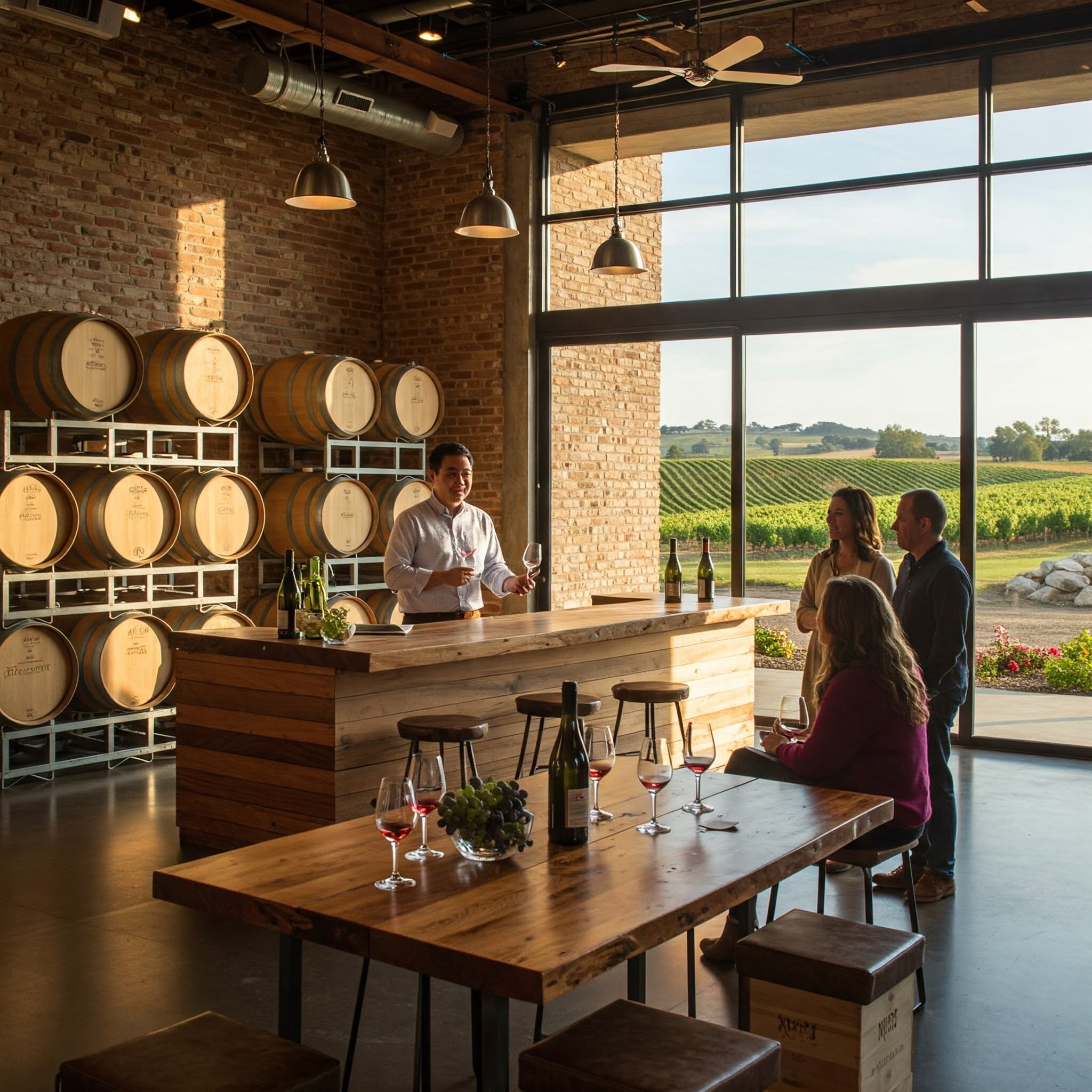

A Tasting Room at a winery is a welcoming space where visitors can sample a variety of wines produced by the winery. It is typically designed to provide a comfortable and inviting atmosphere for guests to relax and enjoy the tasting experience. Tasting Rooms often feature a bar or counter where tastings are conducted, as well as seating areas where guests can linger and savor their wines. The decor of a Tasting Room is usually inspired by the winery's aesthetic and may include elements such as wine barrels, vineyard views, and rustic or elegant furnishings. Overall, a Tasting Room is a key part of the winery experience, offering guests the opportunity to learn about the wines, meet the winemakers, and create lasting memories.