
Appalachian High Country
The Appalachian High Country is an area located in the Appalachian Mountains of the Eastern United States. Known for its beautiful landscapes, impressive biodiversity, and cultural history, this highland region includes parts of several states: North Carolina, Tennessee, Virginia, and West Virginia.
The Appalachian High Country has an elevation ranging from approximately 1,500 to over 6,000 feet, which leads to a climate that's much colder than in the surrounding lowlands. The region is home to many endemic species of plants and animals that are well adapted to the area's high altitudes, cold winters, and short growing season.
In terms of landscape, the region features a mixture of rolling hills, rugged mountains, and deep river valleys. Among the best known natural features of the region are the Blue Ridge Mountains and the Great Smoky Mountains. The Appalachian High Country is also home to the Appalachian Trail, a popular hiking trail that stretches across 14 states from Georgia to Maine.
Culture-wise, the Appalachian High Country has a rich tradition of music, storytelling, and handicrafts. Old-time music and bluegrass are especially popular in this region, with many local festivals celebrating these art forms.
Rural and small-town life is common throughout the region. Traditionally, the economy has been heavily reliant on industries like mining, logging, and farming. However, in recent decades, tourism, outdoor recreation, and service sector jobs have become increasingly important. Notable cities and towns in this region include Boone and Asheville in North Carolina, and Abingdon in Virginia.
Overall, the Appalachian High Country is a scenic and celebrated area, offering both cultural history and natural beauty to its residents and visitors alike.
Aprilia
Aprilia is an Italian motorcycle company and one of the brands owned by Piaggio, the world's fourth largest motorcycle manufacturer. Established after World War II, Aprilia, as a company, started as a bicycle production factory in Noale, Italy.
The company initially produced bicycles, moving to manufacture scooters and small-capacity motorcycles during the late sixties to early seventies. It wasn't until the late 1980s that Aprilia began producing large sportbikes, such as the 1,000cc V-twin RSV Mille and the V4 RSV4.
Aprilia is known for its successful exploits in motorcycle racing, with numerous wins in the MotoGP, 125 and 250cc GP classes, Superbike World Championship, and off-road disciplines. Its motorcycles are characterized by their high-performance engines, advanced technology, and distinctive sporty designs.
Apart from race-inspired bikes, Aprilia also produces scooters, underbone motorcycles, and off-road bikes. Some of the most popular models from Aprilia include the Aprilia RSV4, Aprilia Tuono, and Aprilia Dorsoduro.
Despite its sporting reputation, Aprilia offers a range of motorcycles for various uses, including street, racing, and adventure touring. The brand is synonymous with offering riders cutting-edge technology, great handling, and Italian style, making it an appealing choice for many riders.
Aragon
Aragon is an autonomous community in Spain, located in the northeastern part of the country. It is bordered by France to the north and by the Spanish regions of Catalonia to the east, Valencia to the south, and Castilla-La Mancha, Castile and León, Navarre, and La Rioja to the west. The capital of Aragon is Zaragoza, which is also the largest city in the region.
Aragon covers an area of approximately 47,720 square kilometers, making it the fourth largest of Spain's autonomous communities. It has a diverse geography, with a central valley flanked by mountain ranges. The climate varies significantly from north to south, ranging from a cold-temperate humid type in the Pyrenees to a semi-arid climate in the center and south of the region.
The region's economy is largely based on agriculture, with a focus on the production of cereals, vegetables, fruit, and grapes for wine. There is also a significant industrial sector, with a focus on automobile manufacturing and renewable energy.
The history of Aragon dates back to the Roman period, but the region gained prominence in the Middle Ages when it became a kingdom. It played a major role in the Reconquista, when Christian states gradually reconquered the Iberian Peninsula from Muslim rule. Aragon later joined with the Kingdom of Castile through a royal marriage, forming the basis of modern Spain.
Aragon is home to a rich cultural heritage, with numerous historic sites, festivals, and traditions. It is known for the Mudéjar Architecture of Aragon, a UNESCO World Heritage Site, which reflects the influence of Islamic art on Christian architecture during the Middle Ages. The region is also famous for the Festival of the Pilar in Zaragoza, one of Spain's biggest religious festivals.
Jura
Jura is a mountain range that stretches across the western border of Switzerland and France. It is known for its beautiful landscapes, dense forests, deep valleys, and large lakes. The Jura Mountains are home to many species of plants and wildlife, including deer, lynx, and numerous bird species.
The region is also renowned for its skiing, hiking, and other outdoor recreational activities. Its highest peak, Crêt de la Neige, stands at 1,720 meters. Many of its vistas offer stunning views of the Alps and the Rhine valley.
In addition to its natural beauty, Jura is known for its watchmaking. The Swiss part of Jura is the birthplace of the Swiss watch industry and is home to many world-renowned watch companies.
Moreover, the region is famous for its wine and cheese. Jura wine, produced in the region's vineyards, and Comté cheese, made in local dairies, are considered delicacies and are popular among gourmands worldwide.
Jura is named after the Jurassic Period, a time in Earth’s history when the area was covered by a tropical sea. Many dinosaur fossils have been found here, and the region has become a center for paleontological studies.
Finally, the Jura region is rich in cultural heritage. It hosts various festivals, cultural events, and houses numerous historical sites, such as ancient castles and abbeys.
Arbois
Arbois is a small picturesque town located in the Jura department in the Bourgogne-Franche-Comté region in eastern France. It is best known for its vineyards and as the center of the Jura wine region.
The town is situated in a valley, surrounded by hills covered with vineyards, which produce some of the best wines in France. The combination of a cool climate and limestone soils provides ideal conditions for wine production, with the region famous for its white wines made from Chardonnay and Savagnin grapes, as well as its red wines from Pinot Noir and Trousseau grapes.
Arbois is also recognized as the hometown of Louis Pasteur, the world-renowned microbiologist and chemist, who made significant contributions to the world of science, medicine, and industry. His family home is now a museum, Maison de Louis Pasteur, where visitors can explore his laboratory and learn about his life and work.
In terms of architecture, the town features charming old buildings, a 13th-century church, and a château known as the Castle of Arbois, adding a medieval charm to the place. The town's central square is lined with cafes and restaurants, offering opportunities to taste the local cuisine along with the renowned Arbois wine.
Arbois is not just about wine and history, it also offers several outdoor activities like hiking, bird-watching, and cross-country skiing during the winter. The nearby Cuisance River provides a beautiful spot for walking and picnicking.
In summary, Arbois is a gem of a town that offers a unique blend of wine, history, beautiful landscapes, and cultural heritage. It is undoubtedly a must-visit for wine lovers and history enthusiasts.
Arborea
Arborea is a town and commune in the province of Oristano, Sardinia, Italy. Named after an ancient Sardinian kingdom, Arborea was developed in the 1920s as part of a fascist initiative to establish new agricultural communities on the island. The town now serves as a hub for the production of crops like fruits, vegetables, and rice, and is known for its fertile farmlands and swamps that have been reclaimed for farming purposes.
The town is also famed for its commitment to sustainability, being the only municipality in Sardinia to produce all of its own electricity from renewable resources. Furthermore, it is known for its horse-riding traditions, centering around the famous breed, the Sardinian Anglo-Arab. Wide tree-lined streets and the proportionally structured layout give it a unique atmosphere and appearance.
The population is a mix of locals and immigrants, including the descendants of settlers from Friuli and Veneto, in mainland Italy, who came here during the initial establishment of the town. Besides Italian, the Friulian language is also spoken here, keeping the settlers' culture alive.
The local landmarks include the church of Madonna del Rosario and the medieval church of Santa Maria delle Grazie. The surrounding landscapes with its wild and lush flora, extensive sand dunes, and pristine coastlines make Arborea a remarkable place to visit.
Crete
Crete is the largest and most populous of the Greek islands, located in the southern part of the Aegean Sea. It has an area of 8,336 square kilometers and a population of approximately 635,000 people. The island is known for its varied terrain, ranging from fine sandy beaches to rugged mountains.
Crete is rich in history and has been inhabited since the Neolithic period. It was the center of the Minoan civilization, which was the earliest known civilization in Europe. Key archaeological sites include the palaces of Knossos and Phaistos, as well as the ancient city of Gortyn.
Crete is divided into four regional units: Chania, Rethymno, Heraklion, and Lasithi. Heraklion is the largest city and serves as the island's capital. The island has a mild Mediterranean climate with hot, dry summers and mild, rainy winters.
The economy of Crete is largely based on tourism, agriculture, and some industrial activity. The island is famous for its healthy diet, known as the Cretan Diet, consisting mainly of food production from local agricultural products.
Culture-wise, Crete is well known for its music and dances. Lyra is the dominant folk instrument on the island, which has a rich tradition of folk poetry and music. Locals also hold religious feasts and festivals throughout the year.
Crete is also home to a number of species of plants and animals that are unique to the island. It has three natural parks and numerous protected areas that conserve its biodiversity. Samaria Gorge National Park is one of the most famous and visited natural sites, offering stunning hiking trails.
Archanes
Archanes is a historical and picturesque town located approximately 16 kilometers south of Heraklion, on the island of Crete in Greece. Nestled at the foot of Mount Giouhtas, Archanes is known for its charming streets, colourful architecture, and rich archaeological history.
The town, inhabited since Neolithic times, is home to one of the most significant archaeological sites in Crete - the Minoan Palace of Archanes, which dates back to the Bronze Age. Many other Minoan relics can also be found in and around the town.
Archanes is divided into two main parts: Epano Archanes (Upper Archanes) and Kato Archanes (Lower Archanes). The upper part is the old town, featuring traditional stone buildings, narrow alleys, and quaint squares. Lower Archanes is where modern development and agriculture, especially vineyards and olive trees, take place.
The town is also renowned for its wine production, with numerous wineries that offer tasting tours. Local cuisine is another highlight, with a variety of taverns serving traditional Cretan dishes.
In addition to its historic and cultural attractions, Archanes is also a hub for outdoor activities, with many opportunities for hiking and bird watching. The region around Archanes hosts a variety of animals and plants, including several endemic species. The E4 European long-distance path, a major hiking route, passes through the town.
Archanes has won awards for its sustainability efforts and its preservation of tradition and heritage. It's a place where the past and the present coexist harmoniously, offering a unique experience for visitors.
South America
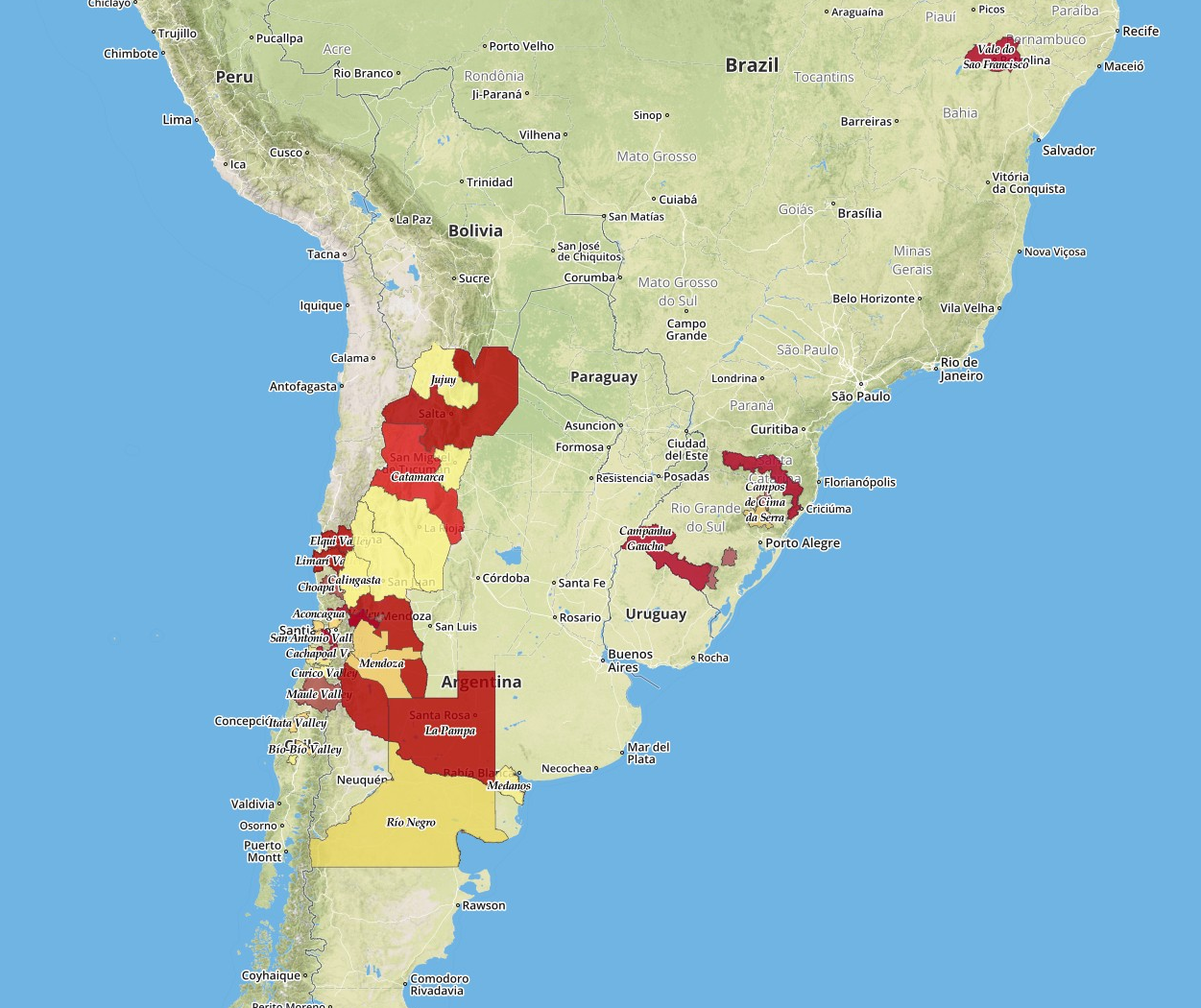
The South America Wine Region is renowned globally for its exquisite wines, with a rich history dating back to the 16th century. The region's diverse geography, ranging from the high-altitude slopes of the Andes to the coastal plains, provides an ideal environment for vine cultivation.
Predominantly known for its production of Malbec, Cabernet Sauvignon, and Carmenere, the region's vineyards span across several countries, including Argentina, Chile, Uruguay, and Brazil. Each country contributes its unique touch to the wine industry, thanks to the varying climates and terrains.
Argentina, the largest wine producer in South America, is celebrated for its Malbec wines, while Chile, with its Mediterranean climate, is recognized for its Cabernet Sauvignon and Carmenere. Uruguay, on the other hand, is famous for its Tannat wines, and Brazil, although a smaller player, is gaining recognition for its sparkling wines.
The South America Wine Region is not only known for its wine production but also for its picturesque landscapes, making it a popular destination for wine tourism. Visitors can enjoy wine tasting tours, vineyard visits, and gastronomic experiences, all while soaking in the stunning views of the vine-clad mountains and valleys.
Innovation and sustainability are also key features of the South America Wine Region. Many vineyards are adopting organic and biodynamic farming practices, contributing to the production of high-quality, eco-friendly wines.
In summary, the South America Wine Region offers a rich diversity of wines, thanks to its varied climates, terrains, and innovative wine-making techniques. It is a region where tradition meets innovation, resulting in wines that are enjoyed by connoisseurs and casual drinkers alike.