

Georgia
The wine region in the state of Georgia, United States, is an emerging area known for its diverse climate and unique terroir. Nestled in the southeastern part of the country, this region benefits from a mix of warm temperatures and cool mountain breezes, particularly in the northern areas near the Appalachian Mountains. This climate variation allows for the cultivation of a wide range of grape varieties.
Georgia's wine industry has seen significant growth over the past few decades, with an increasing number of vineyards and wineries establishing themselves in the region. The state's wine producers are known for experimenting with both traditional European grape varieties, such as Cabernet Sauvignon, Merlot, and Chardonnay, and native American varieties like Muscadine, which thrives in the warmer climate.
The region's wineries often focus on sustainable and innovative practices, contributing to the production of high-quality wines that are gaining recognition both nationally and internationally. Wine tourism is also a growing industry in Georgia, with many wineries offering tastings, tours, and events that showcase the local wine culture and scenic landscapes.
Overall, the Georgia wine region is characterized by its commitment to quality and diversity, making it an exciting destination for wine enthusiasts looking to explore new and distinctive flavors.
Americas
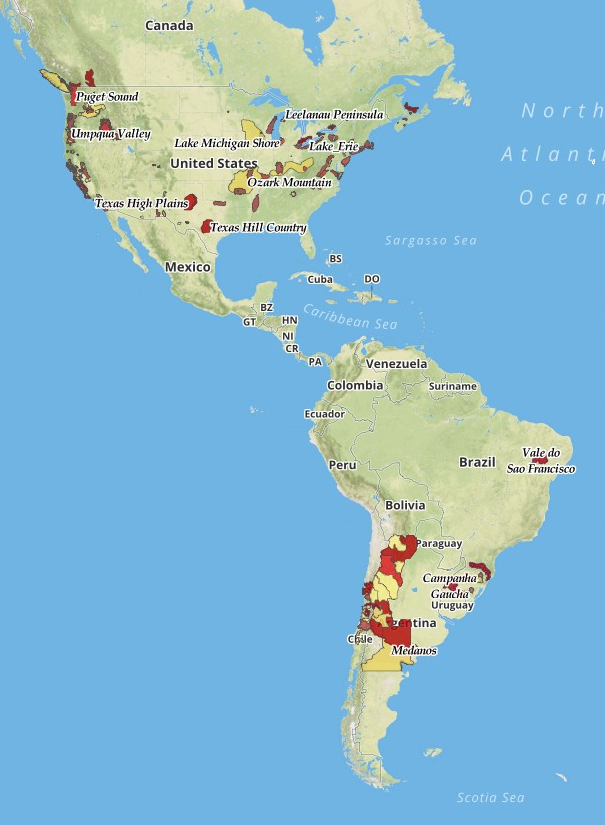
North and South America boast diverse and renowned wine regions, each with unique characteristics and offerings.
In North America, the wine region primarily spans across the United States and Canada. The United States, particularly California, is globally recognized for its wine production, contributing to 90% of the total North American output. Napa Valley and Sonoma County, known for their Cabernet Sauvignon and Chardonnay, are among the most prestigious wine regions. Other significant areas include Oregon's Willamette Valley, famous for Pinot Noir, and Washington State's Columbia Valley, known for its Merlot and Riesling. Canada, on the other hand, is celebrated for its ice wines, with Niagara Peninsula and Okanagan Valley as the leading wine-producing areas.
South America, with its diverse climates and terrains, is home to several world-class wine regions. Argentina, the fifth largest wine producer globally, is renowned for its Malbec, primarily grown in Mendoza. Chile, with its Mediterranean climate, is famous for its Cabernet Sauvignon and Carménère, especially in the Central Valley region. Other notable wine regions include Uruguay, known for Tannat, and Brazil, recognized for its sparkling wines.
Both continents offer a rich variety of wines, reflecting the unique terroir and winemaking traditions of each region.
North Fork of Roanoke
The North Fork of Roanoke is an 11 mile long tributary of the Roanoke River in southwest Virginia. It originates in Roanoke County and flows through Montgomery County before joining the South Fork to form the Roanoke River. The area surrounding the North Fork is predominantly rural with a mix of forest and farmland. The river is known for its scenic beauty and diverse wildlife. In terms of recreation, it offers opportunities for fishing, particularly for smallmouth bass and catfish.
Northern Cape
The Northern Cape is a province in South Africa, known for its vast expanses of desert and semi-desert landscapes. It is the largest and most sparsely populated province in South Africa, covering an area of over 372,000 square kilometers, which is nearly a third of the whole country. Despite its size, it has the smallest population of the nine provinces, with slightly over a million inhabitants.
The province is rich in mineral resources, with large deposits of diamonds, copper, and iron ore. It is particularly famous for the city of Kimberley, the site of a major diamond rush in the 19th century and home to the Big Hole, one of the largest hand-made holes in the world, dug during diamond mining operations.
The Northern Cape hosts several national parks and nature reserves, including the popular Kgalagadi Transfrontier Park, known for its incredible red sand dunes and abundant wildlife. The region also houses the Richtersveld Cultural and Botanical Landscape, a UNESCO World Heritage site, due to its unique biodiversity and the cultural significance to the Indigenous Nama people.
The climate is typically semi-arid to arid, with scorching summers and cool winters. Despite the arid conditions, the Northern Cape is home to one of the most spectacular natural phenomena in South Africa, the Namaqualand Flower Route. Each spring, usually between August and September, vast areas of the province are transformed into a colourful wildflower display, attracting tourists from around the world.
The main languages spoken in the Northern Cape are Afrikaans, Setswana, and Xhosa. The province also has a diverse cultural heritage, with influences from various indigenous and immigrant communities, including Khoisan, Nama, San, and European settlers.
Northern Neck George Washington Birthplace
Northern Neck George Washington Birthplace, also known as the George Washington Birthplace National Monument, is a historic site located in Westmoreland County, Virginia, USA. This national monument was established on January 23, 1930, to preserve and honor the location where the first President of the United States, George Washington, was born on February 22, 1732.
The site spans across a 550-acre area that includes parts of Popes Creek, where Washington spent much of his early childhood. Visitors to the site are presented with a historical landscape including an 18th-century tobacco farm, a colonial revival house built in 1931, and a brick monument built in 1896 to commemorate the site.
At the visitor center, visitors can explore a museum featuring exhibits on George Washington, colonial life, and farm life. The park also offers hiking trails, picnic areas, and events that include historical demonstrations.
The birthplace home itself is no longer standing, but a Memorial House was constructed in the 1930s by the George Washington Birthplace Association who owned the property at that time. The Memorial House, a 18th-century style plantation home, includes a kitchen house, a heritage breed livestock, and outbuildings.
In brief, Northern Neck George Washington Birthplace is a historic and significant site that offers valuable insights into the life and childhood of one of the most important figures in American history.
Northern New England
Northern New England refers to three states in the northeastern region of the United States: Maine, New Hampshire, and Vermont. These states are known for their serene landscapes, rugged coastlines and charming small towns.
Maine, the largest of the three states, is famous for its rocky coastline, scenic waterways, and beautiful forests. It is a prime destination for outdoor enthusiasts who enjoy activities such as hiking, camping, fishing and hunting. Maine is also known for its seafood, especially lobsters and clams.
New Hampshire, while smaller, is no less beautiful. It boasts the White Mountains, a region that draws tourists year-round for skiing, snowboarding, hiking and fall foliage viewing. The state also has a small Atlantic coastline and is home to Portsmouth, a historic seaport town with a vibrant arts scene.
Vermont, the only landlocked state in Northern New England, is renowned for its stunning landscapes that include rolling hills, picturesque farmlands, and dense forests. The Green Mountains run through the state offering great opportunities for hiking and skiing. Vermont is also famous for its dairy farms particularly cheese and for its maple syrup production.
Aside from the abundant natural beauty, Northern New England also has a rich cultural history, dating back to the Native American tribes that once inhabited the region, to the early European settlers. Many structures and sites from the 17th, 18th and 19th centuries have been preserved and are open to the public.
The region has a largely rural character and a slower pace of life than many parts of the U.S. The economy is based on a combination of manufacturing, agriculture, and a growing service sector. Education and health services are also significant contributors to the economy.
Overall, Northern New England offers a unique blend of natural beauty, historical sites, and inviting small towns, and serves as a perfect example of 'Old America.'
Northern Territory
The Northern Territory is a large federal territory in Australia, located in the central and central northern regions. It shares borders with Western Australia to the west, South Australia to the south, and Queensland to the east.
Spanning over 1.42 million square kilometres, it represents about one sixth of Australia's total area, making it the third largest Australian division after Western Australia and Queensland. Despite its vast size, the Northern Territory is least populated of all the country's states and territories, with the majority of its over 240,000 residents living in the capital city, Darwin.
The Northern Territory is renowned for its tropical climate and its two distinctive seasons: the wet and the dry season. Its topography is diverse and features natural wonders like the red sandy deserts of its central region, vast floodplains in its far north, and iconic landmarks like the Kakadu National Park, Uluru/Ayers Rock and the Kata Tjuta rock formations.
Its economy is largely reliant on tourism and mining. Aboriginal Australians constitute approximately a quarter of the Northern Territory's population and it is rich in Indigenous culture and history, holding some of the oldest examples of rock art in the world.
English is predominantly spoken in the Northern Territory, with Aboriginal languages also being spoken by a proportion of the Indigenous communities. It became self-governing in 1978, with its government exercising similar responsibilities that the states have. Despite this, there are ongoing discussions and debates concerning the potential for the Northern Territory to achieve full statehood.
Nova Zagora GCAO
Nova Zagora GCAO, also known as Nova Zagora Municipality, is an administrative division in southeastern Bulgaria. It is part of the Sliven Province. The municipality consists of 19 settlements including one town, Nova Zagora, and 17 villages. As of its most recent census data, the total population of the municipality was approximately 47,000 people.
Nova Zagora Municipality is known for its rich history dating back to ancient times. Numerous archaeological finds, including ancient settlements and necropolises, indicate that the area has been inhabited since the Neolithic Age. The modern-day town of Nova Zagora, the administrative center of the municipality, was established in the late 17th century.
This municipality has a mixed economy with sectors including agriculture, manufacturing, commerce and services contributing to its growth. It is crossed by the Trakiya motorway, which connects the capital Sofia with the city of Burgas on the Black Sea coast, providing convenient transport links.
Nova Zagora's natural assets include its fertile lands and a favorable climate, which make it a conducive region for farming. The municipality is also home to several schools, cultural centers, and health care institutions, making it a developed region within the Sliven Province.
Novi Pazar GCAO
Novi Pazar GCAO wine is a high-quality wine produced in the Novi Pazar region. It is known for its rich flavor profile, which includes notes of dark fruits, spices, and earthy undertones. The wine is made from carefully selected grapes grown in the region, and it undergoes a meticulous fermentation and aging process to ensure optimal taste and quality. Novi Pazar GCAO wine is highly regarded among wine enthusiasts for its complexity and depth of flavor, making it a popular choice for special occasions and wine connoisseurs.I'm sorry, but there doesn't seem to be any concrete information available regarding "Novi Pazar GCAO". It's possible that there may be a typo or misunderstanding in your request. If you're referring to Novi Pazar, it's a city located in the Raška District of southwestern Serbia. If GCAO refers to a specific organization or aspect of the city, you may need to provide a more specific context for a detailed description.