

Cabernet Sauvignon
Cabernet Sauvignon is a full-bodied red wine grape variety that originated from the French regions of Bordeaux. It's known for its thick, durable skin and the vine’s resistance to the elements. Cabernet Sauvignon is rich, intense and complex; usually offering a bouquet of dark cherry, blackberry, cassis, spice, mocha and cedarwood.
This red wine grape typically matures late in the growth season which can lead to deep, tannic wines with notes of blackcurrants, berries, plums, bell pepper, green olive, as well as spices such as vanilla and black pepper. It's often aged in oak which adds flavor complexities of vanilla, clove, smoke, and even a cedar aroma.
Cabernet Sauvignon is known for its high level of tannins, which give it structure and make it a great candidate for aging. Its full-bodied nature and high acid content enable it to pair well with a variety of foods, particularly red meats and strong cheeses.
<div class="wikipedia-data"><p><b>Cabernet Sauvignon</b> (<small>French: </small><span title="Representation in the International Phonetic Alphabet (IPA)">[kabɛʁnɛ soviˈɲɔ̃]</span>) is one of the world's most widely recognized red wine grape varieties. It is grown in nearly every major wine producing country among a diverse spectrum of climates from Canada's Okanagan Valley to Lebanon's Beqaa Valley. Cabernet Sauvignon became internationally recognized through its prominence in Bordeaux wines where it is often blended with Merlot and Cabernet Franc. From France and Spain, the grape spread across Europe and to the New World where it found new homes in places like California's Santa Cruz Mountains, Paso Robles, Napa Valley, New Zealand's Hawkes Bay, South Africa's Stellenbosch region, Australia's Margaret River and Coonawarra regions, and Chile's Maipo Valley and Colchagua. For most of the 20th century, it was the world's most widely planted premium red wine grape until it was surpassed by Merlot in the 1990s.
However, by 2015, Cabernet Sauvignon had once again become the most widely planted wine grape, with a total of 341,000 hectares (3,410 km<sup>2</sup>) under vine worldwide.</p><p>Despite its prominence in the industry, the grape is a relatively new variety, the product of a chance crossing between Cabernet Franc and Sauvignon blanc during the 17th century in southwestern France. Its popularity is often attributed to its ease of cultivation—the grapes have thick skins and the vines are hardy and naturally low yielding, budding late to avoid frost and resistant to viticultural hazards such as rot and insects—and to its consistent presentation of structure and flavours which express the typical character ("typicity") of the variety. Familiarity and ease of pronunciation have helped to sell Cabernet Sauvignon wines to consumers, even when from unfamiliar wine regions. Its widespread popularity has also contributed to criticism of the grape as a "colonizer" that takes over wine regions at the expense of native grape varieties.</p><p>The classic profile of Cabernet Sauvignon tends to be full-bodied wines with high tannins and noticeable acidity that contributes to the wine's aging potential. In cooler climates, Cabernet Sauvignon tends to produce wines with blackcurrant notes that can be accompanied by green bell pepper notes, mint and cedar which will all become more pronounced as the wine ages. In more moderate climates the blackcurrant notes are often seen with black cherry and black olive notes while in very hot climates the currant flavors can veer towards the over-ripe and "jammy" side. In parts of Australia, particularly the Coonawarra wine region of South Australia, Cabernet Sauvignon wines tend to have a characteristic eucalyptus or menthol notes.</p><div class="wikipedia-link">Wikipedia: <a href="https://en.wikipedia.org/wiki/Cabernet Sauvignon">Cabernet Sauvignon</a></div></div>
Chardonnay
Chardonnay is a green-skinned grape variety used to produce some of the world's most popular white wines. It originally comes from the Burgundy region in eastern France but is now grown wherever wine is produced, from England to New Zealand.
The flavors of Chardonnay can range widely depending on where it's grown and how it's made. The taste can range from clean and crisp with a lemony zing in places like Chablis, France, to ripe and tropical in warmer climates like California. In cool climates, Chardonnay tends to produce wines of higher acidity with flavors of green plum, apple, and pear.
In warmer locations, the flavors become more citrus, peach, and melon, while in very warm locations, more fig and tropical fruit notes such as banana and mango come out. Wines that have undergone malolactic fermentation will also have softer acidity and fruit flavors with butter, popcorn and toasted hazelnut notes.
Chardonnay also plays a significant part in making Champagne and is also one of the main ingredients in many sparkling wines around the world.
While it can be enjoyed young, the best expressions of Chardonnay are aged in oak and can stand up to several years in bottle, developing more complex nutty and honeyed notes over time.
<div class="wikipedia-data"><p><b>Chardonnay</b> (<span><small>UK: </small></span>, <span><small>US: </small></span>, <small>French: </small><span title="Representation in the International Phonetic Alphabet (IPA)">[ʃaʁdɔnɛ]</span> <span>(<span><span><span></span>listen</span></span>)</span>) is a green-skinned grape variety used in the production of white wine. The variety originated in the Burgundy wine region of eastern France, but is now grown wherever wine is produced, from England to New Zealand. For new and developing wine regions, growing Chardonnay is seen as a ‘rite of passage’ and an easy entry into the international wine market.</p><p>The Chardonnay grape itself is neutral, with many of the flavors commonly associated with the wine being derived from such influences as <i>terroir</i> and oak. It is vinified in many different styles, from the lean, crisply mineral wines of Chablis, France, to New World wines with oak and tropical fruit flavors. In cool climates (such as Chablis and the Carneros AVA of California), Chardonnay wine tends to be medium to light body with noticeable acidity and flavors of green plum, apple, and pear. In warmer locations (such as the Adelaide Hills and Mornington Peninsula in Australia and Gisborne and Marlborough region of New Zealand), the flavors become more citrus, peach, and melon, while in very warm locations (such as the Central Coast AVA of California), more fig and tropical fruit notes such as banana and mango come out. Wines that have gone through malolactic fermentation tend to have softer acidity and fruit flavors with buttery mouthfeel and hazelnut notes.</p><p>Chardonnay is an important component of many sparkling wines around the world, including Champagne and Franciacorta in Italy.
</p><p>Chardonnay's popularity peaked in the late 1980s, then gave way to a backlash among those wine connoisseurs who saw the grape as a leading negative component of the globalization of wine. Nonetheless, it is one of the most widely planted grape varieties, with 210,000 hectares (520,000 acres) worldwide, second only to Airén among white wine grapes and fifth among all wine grapes.</p><div class="wikipedia-link">Wikipedia: <a href="https://en.wikipedia.org/wiki/Chardonnay">Chardonnay</a></div></div>
Pinot Grigio
Pinot Grigio is a white grape variety of the species Vitis vinifera, originating from Italy. The grape is also known as Pinot Gris in France and other parts of the world. Pinot Grigio grapes are known for their grayish-blue color, although the hues can also range from pink to white.
The wines produced from this grape can vary greatly and are dependent on the region and winemaking style they come from. They can range from light-bodied, crisp and fresh with floral notes in Italy, to full-bodied, richer, spicier and more viscous in Alsace, France.
Common flavor profiles of Pinot Grigio include pear, apple, stone fruit, tropical fruit, and honeysuckle. They are typically best consumed young and are known for their refreshing and high acidity. Because of their neutral taste, Pinot Grigio wines are often used as an aperitif or served with seafood, light pastas, and cheese dishes.
<div class="wikipedia-data"><div class="wikipedia-link">Wikipedia: <a href="https://en.wikipedia.org/wiki/Pinot Grigio">Pinot Grigio</a></div></div>
Food
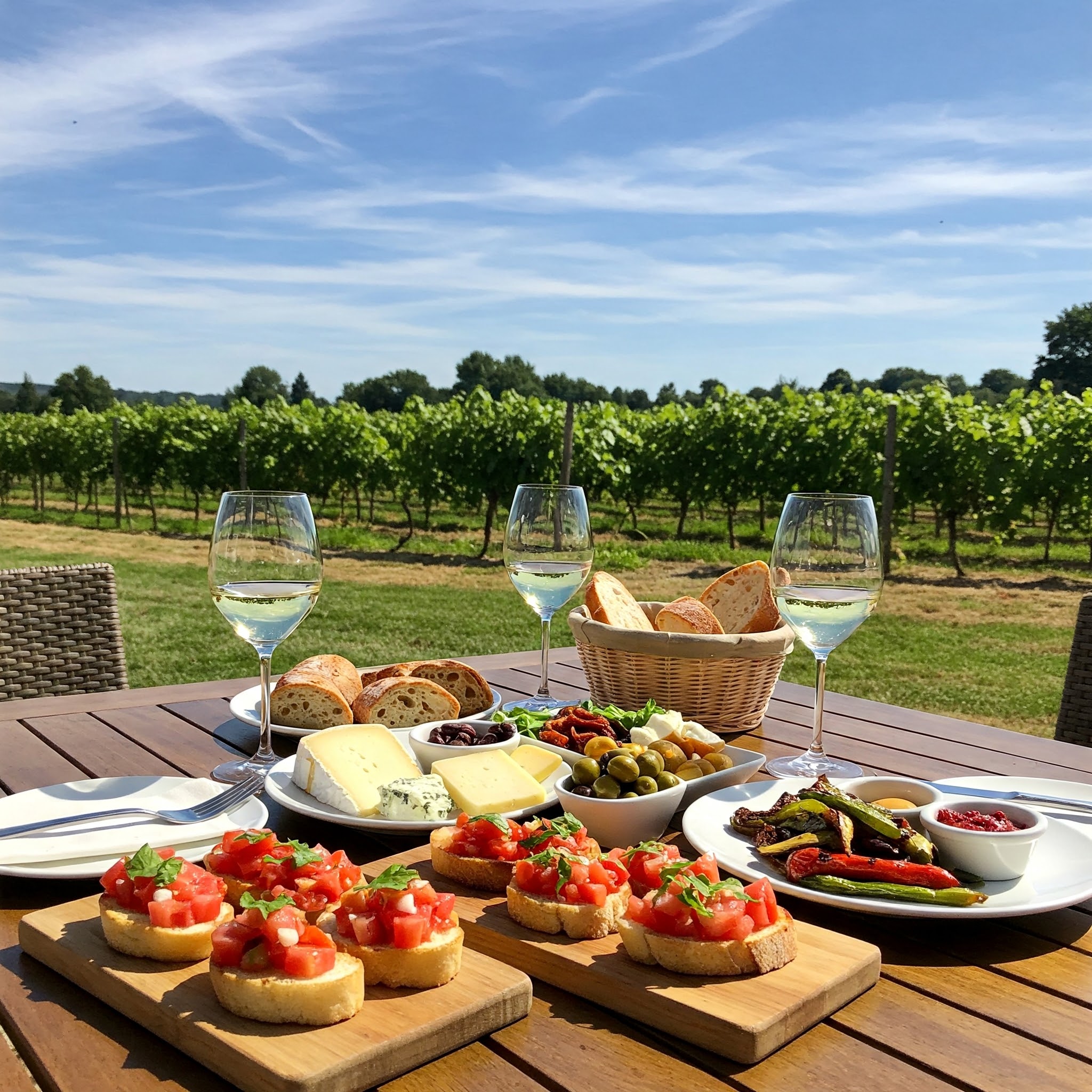
Food at a winery is often designed to complement the wines being served. The menu typically features a selection of small plates, charcuterie boards, artisanal cheeses, and gourmet sandwiches. These dishes are carefully curated to enhance the tasting experience and showcase local ingredients. Many wineries also offer seasonal specials and food pairings to highlight the flavors of their wines. Overall, dining at a winery is a delightful experience that combines the pleasures of good food and wine in a picturesque setting.
Coro Mendocino
Coro Mendocino is a wine region located in Northern California's Mendocino County. The region is particularly renowned for its Coro Mendocino wine, which is primarily made from the Zinfandel grape variety.
The term "Coro" signifies "chorus" in Italian, reflecting the collaborative nature of the area's winemakers. The Coro Mendocino consortium, founded in 2001, is composed of various independently owned wineries working together to create distinctive wines that reflect the region's terroir.
A strict set of protocols is followed by the wineries to acquire the Coro Mendocino label. These rules govern the percentages of Zinfandel, Syrah, and Petite Sirah that each bottle must contain, as well as ageing and bottling processes.
The Coro Mendocino wines are known for their robust flavors, firm tannins, and balanced acidity. These wines often display fruity notes of blackberry, black cherry, and plum, along with spicy and earthy undertones. They are best enjoyed with hearty meat dishes, such as grilled steak or spicy sausages.
Merlot
Merlot is a dark blue-colored wine grape variety, that is used both as a blending grape and for varietal wines. The name Merlot is thought to be a diminutive of merle, the French name for the blackbird, probably a reference to the color of the grape. Its versatility and soft, plush texture have made it one of the most popular grape varieties in the world.
Merlot wines tend to feature rich flavors of ripe plum, black cherry, and herbs, often combined with notes of tobacco and spice due to aging in oak barrels. These wines typically have medium acidity and tannins, which contribute to their smooth, approachable character. Many Merlot wines have a round, full-bodied profile with a velvety mouthfeel.
The Merlot grape is one of the primary grapes used in Bordeaux wine, and it is the most widely planted grape in the Bordeaux wine regions. Merlot is also one of the most popular red wine varietals in many markets. This flexibility has helped to maintain its popularity, even as the taste for other red wine varietals like Cabernet Sauvignon and Syrah has grown.
<div class="wikipedia-data"><p><b>Merlot</b> is a dark blue-colored wine grape variety, that is used as both a blending grape and for varietal wines. The name <i>Merlot</i> is thought to be a diminutive of <i>merle</i>, the French name for the blackbird, probably a reference to the color of the grape. Its softness and "fleshiness", combined with its earlier ripening, makes Merlot a popular grape for blending with the sterner, later-ripening Cabernet Sauvignon, which tends to be higher in tannin.</p><p>Along with Cabernet Sauvignon, Cabernet Franc, Shiraz Cabernet, Malbec and Petit Verdot, Merlot is one of the primary grapes used in Bordeaux wine, and it is the most widely planted grape in the Bordeaux wine regions. Merlot is also one of the most popular red wine varietals in many markets. This flexibility has helped to make it one of the world's most planted grape varieties. As of 2004, Merlot was estimated to be the third most grown variety at 260,000 hectares (640,000 acres) globally.
The area planted to Merlot has continued to increase, with 266,000 hectares (660,000 acres) in 2015.</p><p>While Merlot is made across the globe, there tend to be two main styles. The "International style" favored by many New World wine regions tends to emphasize late harvesting to gain physiological ripeness and produce inky, purple colored wines that are full in body with high alcohol and lush, velvety tannins with intense, plum and blackberry fruit. While this international style is practiced by many Bordeaux wine producers, the traditional "Bordeaux style" of Merlot involves harvesting Merlot earlier to maintain acidity and producing more medium-bodied wines with moderate alcohol levels that have fresh, red fruit flavors (raspberries, strawberries) and potentially leafy, vegetal notes.</p><div class="wikipedia-link">Wikipedia: <a href="https://en.wikipedia.org/wiki/Merlot">Merlot</a></div></div>
Gewürztraminer
Gewürztraminer is a white wine grape variety that originated in the Alsace region of France. The name translates to "spice tramine," indicating its aromatic and flavor profile.
Gewürztraminer grapes produce a full-bodied, aromatic wine, known for its high alcohol content and moderate to low acidity. The wines are often off-dry or sweet, with a golden yellow color and a medium to full body.
It is renowned for its lychee-like flavor profile, although it can also display notes of peach, grapefruit, rose petal, ginger, and spice. Some Gewürztraminers even have a slightly smoky quality. As it ages, it can develop more complex and exotic flavors like honey or apricot jam.
This is a bold varietal that pairs well with a variety of spicy foods or strong-flavored cheeses, making it popular in many cuisines around the world. It's appreciated for its distinctive and potent flavor profile and aromatic intensity.
<div class="wikipedia-data"><dl><dd><i>Many grape names redirect here. For the list, see below: Synonyms</i>.</dd></dl>
<p><b>Gewürztraminer</b> (<small>German: </small><span title="Representation in the International Phonetic Alphabet (IPA)">[ɡəˈvʏʁtstʁaˈmiːnɐ]</span>) is an aromatic wine grape variety, used in white wines, and performs best in cooler climates. In English, it is sometimes referred to colloquially as <b>Gewürz</b> (<span></span>; although this is never the case in German, because "Gewürz" means "herb" or "spice"), and in French it is written <b><i lang="fr" title="French language text">Gewurztraminer</i></b> (without the umlaut). Gewürztraminer is a variety with a pink to red skin colour, which makes it a "white wine grape" as opposed to the blue to black-skinned varieties commonly referred to as "red wine grapes". The variety has high natural sugar and the wines are white and usually off-dry, with a flamboyant bouquet of lychees. Indeed, Gewürztraminer and lychees share the same aroma compounds. Dry Gewürztraminers may also have aromas of roses, passion fruit and floral notes. It is not uncommon to notice some <i>spritz</i> (fine bubbles on the inside of the glass).
</p><p>Gewürztraminer's sweetness may offset the spice in Southeast Asian cuisine.</p><div class="wikipedia-link">Wikipedia: <a href="https://en.wikipedia.org/wiki/Gewürztraminer">Gewürztraminer</a></div><…;
Sauvignon Blanc
Sauvignon Blanc is a green-skinned grape variety that originates from the Bordeaux region of France. The grape most likely gets its name from the French words 'sauvage' (wild) and 'blanc' (white) due to its early origins as an indigenous grape in South West France.
The varietal is famous for its crisp, dry, and refreshing white wine. Sauvignon Blanc is usually consumed young as its flavors fade with time. The flavor profile of Sauvignon Blanc wine can vary drastically depending on the climate where it’s grown.
In cooler climates such as France and New Zealand, the wine often has a green hue with flavors of lime, green apple, passion fruit, and grass. When produced in warmer climates like California or Australia, the flavors tend to lean toward peach, melon, or grapefruit with a heavier texture.
Aside from its standalone qualities, Sauvignon Blanc is also used to blend with other varietals like Sémillon and it’s the grape used to make the sweet wine Sauternes.
<div class="wikipedia-data"><div class="wikipedia-link">Wikipedia: <a href="https://en.wikipedia.org/wiki/Sauvignon Blanc">Sauvignon Blanc</a></div></div>
West Virginia
West Virginia's wine regions offer a unique blend of history, climate, and geography that contribute to the distinct character of its wines. The state is home to several wineries and vineyards, each benefiting from the diverse Appalachian terrain and varying microclimates. The rolling hills and fertile valleys provide ideal conditions for growing a variety of grape species, including both native and hybrid varieties.
The Eastern Panhandle region, with its proximity to the Shenandoah Valley, is known for its rich soils and moderate climate, which are conducive to producing high-quality wines. This area often features vineyards that focus on traditional European grape varieties, such as Chardonnay and Cabernet Franc.
In the central part of the state, the Kanawha Valley offers a different terroir, with its own unique set of climatic conditions. The vineyards here often experiment with hybrid grapes that are well-suited to the local environment, producing wines with distinctive flavors and aromas.
The state's wine industry is relatively small but growing, with an emphasis on artisanal production and local varietals. Many wineries in West Virginia focus on sustainable practices and offer visitors a chance to experience the winemaking process firsthand through tours and tastings. This commitment to quality and sustainability is helping to establish West Virginia as an emerging wine region in the United States.